
Review draft
LOCAL INFLUENCE / BOSTON
A city is not one audience
The value of a local campaign is in the decisions it changes. One citywide brief can need different places, different messengers and different routes to action. Producing more versions of the same message does not resolve those choices.
Genara’s Boston study began with one objective: more eligible residents taking the next step towards a home-energy assessment. The planning envelope was $25,000. The work queried 142 tracts against 17 indicator definitions and developed four place-specific campaign plans. The city stayed the same. The reasons to act, and the route to help, did not.

The local decision comes before the message
Older housing suggested an obvious starting point. The selected West Roxbury area had a large share of homes built before 1980. Looking at household cost pressure changed the priority. Selected areas in Mattapan and Roxbury became more important to the proposed affordability-led plan.
That changed where the planning effort and budget would go. Housing age remained useful context, but it could not carry the whole decision. The campaign needed to distinguish the condition of a place from the reason someone might seek help.
East Boston raised a different problem. The local evidence prompted a proposed route that paired mobile creative and language support with both web and phone options. The response to local conditions was a different handoff, not simply another headline.
The handoff is part of the campaign
The synthetic message test used eight audience profiles. It surfaced a practical weakness: an office-hours phone call could be difficult for someone working a shift. It also exposed ambiguity between asking for advice and needing an owner’s permission for improvements.
The planning response was specific. Keep a web route alongside the phone number. Make the purpose of the call clear. Separate the ability to ask for advice from the permissions that later work might require. A polished message would still have been a poor recommendation if its next step was hard to use.
These decisions belong in the same assignment. A local finding has value when it reaches the budget, the channel role, the messenger choice or the next step. Otherwise, it stays in a research document while the campaign proceeds as before.
One brief should carry through the work
The four Boston plans gave distinct jobs to local creative, search, community referral and media work. A firm could review the proposed allocations and the reasons behind them together. The work remained connected to the original objective: eligible enquiries and assessment bookings.
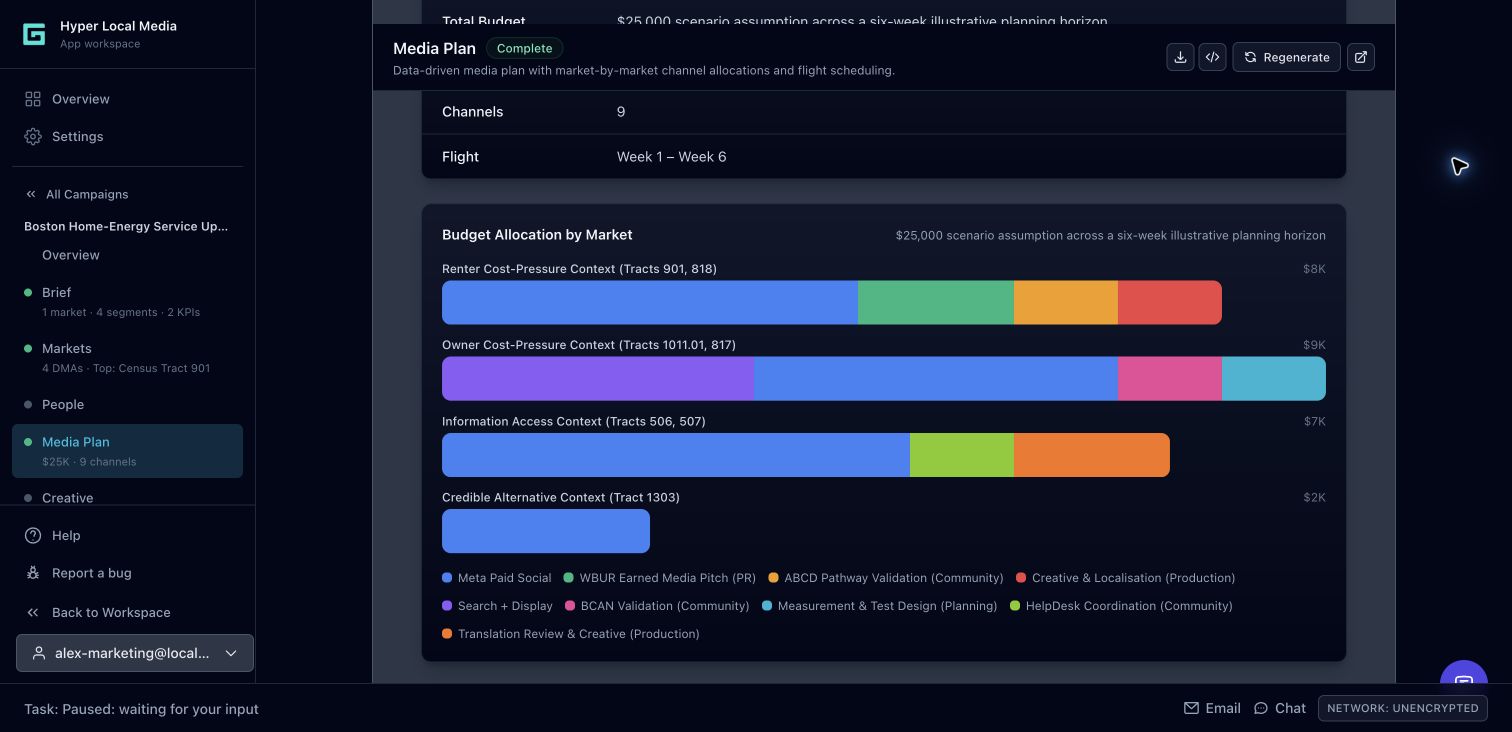
Inside Genara: a $25,000 planning envelope allocated across four local contexts. Chart labels are rounded; named organisations indicate proposed roles, not agreed participation.
View full-size product imageThat is the operating problem Genara is built around. Firms need local context to survive the journey from brief to campaign plan and prepared material. Each new place should add useful decisions without forcing the team to rebuild the whole assignment from scratch.
Genara is the AI operating system for local influence. Its proposition combines the platform with a reference practice that delivers the work. People set the direction and judge the result. The system carries context through the work between those decisions.
The operating model needs evidence
For a firm, the next test is a live brief with an agreed scope and a record of the work delivered. For a strategic acquirer, the question is whether that capability belongs across a wider client base. Boston gives that discussion a concrete starting point: one brief became four local campaign plans before money was committed.
The economic thesis is that this changes the cost of doing local work. The proof still to collect is output per strategist, time spent on comparable assignments and new work won. The longer-term direction is to retain and reuse place-level decisions and learning so future briefs improve. That compounding is a product direction, not a result established by this study.
Persuasion is going local. Agencies are going software. Genara is where the two meet. Let’s discuss the local-influence capability your client base needs.
Illustrative study using real Genara analysis; budgets are planning assumptions and audience feedback was modeled.